UN peacekeeping mission in Western Sahara ends after 35 years
The withdrawal follows a Security Council deadlock where Russia vetoed a US-backed resolution, leaving the desert territory without an international observer force.
By Aiko Lombardi ·
The United Nations peacekeeping mission in Western Sahara ceased operations on Sunday after 35 years of continuous deployment. The withdrawal marks the end of an era for the international oversight of one of Africa's longest-standing territorial disputes. Stéphane Dujarric, the spokesperson for the UN Secretary-General, confirmed the transition in a statement issued on November 1, 2026. He described the date as the start of the liquidation period for the mission. A smaller team will now report to the UN Operational Support Department to manage the transfer of assets and the orderly return of troop-contributing forces.
The decision to end the mission stems directly from a procedural battle in the UN Security Council. On Friday, Russia cast a veto against a United States resolution. That US draft would have supported Morocco's claim to sovereignty over the territory. It also would have formally closed the peacekeeping mission in the coming year. Immediately following the veto, the council considered a rival resolution drafted by Russia. That text sought to extend the mandate of the peacekeepers. The council rejected the Russian proposal in a subsequent vote. The split left the mission without a legal basis for continuation, resulting in its abrupt termination.
Western Sahara is a vast desert region on the Atlantic coast of northwestern Africa. The territory covers an area roughly the size of the US state of Colorado. It holds substantial mineral deposits and rich fishing grounds. Spain previously administered the region before ceding control in 1975. Morocco annexed the territory shortly after that handover. The political group Polisario Front, backed by Algeria, claims the land for an independent state. The UN classifies the region as a non-self-governing territory. Critics of Moroccan control often describe it as the last remaining colony in Africa.
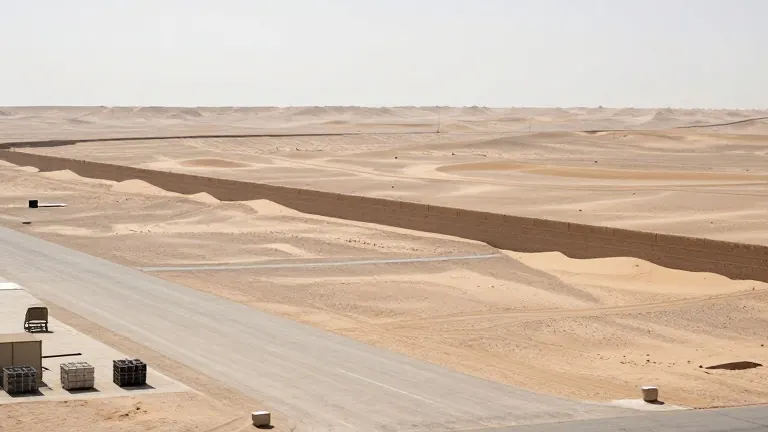
Morocco currently administers the majority of the disputed area. The kingdom maintains control over all territory east of a sand wall it constructed. A narrow strip known as the free zone remains outside direct Moroccan administration. The dispute has shaped Moroccan foreign policy for decades. Rabat has secured the backing of several Western capitals, including Washington, Paris, and London. The government refers to the region as its southern provinces. The palace in Rabat welcomed the end of the UN mission. It characterized the peacekeeping force as a tool used to internationalize the dispute.
The Polisario Front reacted with sharp criticism. The group labeled the decision to end the mission as unacceptable. Algeria, a key ally of the independence movement, voiced deep regret over the outcome. The Algerian Ministry of Foreign Affairs criticized the US proposal for containing excessive bias. The diplomatic friction between Washington and Moscow in the Security Council created a vacuum where neither side could secure the votes needed to maintain the status quo.
The conflict in Western Sahara has a violent history. After the 1975 annexation, the dispute escalated into an armed war. The fighting lasted more than 15 years. According to the French Senate, the conflict claimed more than 16,000 lives on both sides. The UN mission was established in 1991 to monitor a ceasefire and facilitate a political solution. It was extended repeatedly over the following decades. The 2026 termination leaves the region without a neutral international presence to monitor the border and the political situation.
The withdrawal of blue helmets raises questions about regional stability. The territory sits at a strategic location near key maritime routes. The mineral and fishing resources make the area economically important to neighboring states. The end of the mission does not resolve the underlying sovereignty claim. Morocco maintains its position that full integration of the territory is the primary objective. The Polisario Front continues to push for independence. The absence of a UN observer force means future incidents along the sand wall will be resolved primarily through bilateral diplomatic channels.
Source: Greenwich Time