6% of 12,000 records: The Loch Raven anomaly
Federal archives confirm that a 1958 sighting over a Baltimore County reservoir was officially classified as unidentifiable after witnesses reported physical burns and a loud explosion.
By Sophie Zhang ·
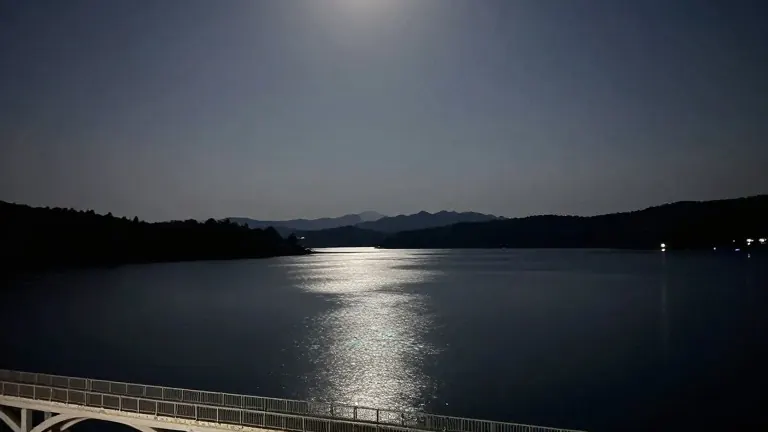
A bright, egg-shaped object hovered 75 to 100 feet above the Loch Raven Reservoir bridge on the night of October 26, 1958. Two men, Phillip Small and Alvin Cohen, witnessed the iridescent orb before it shot into the sky with a flash of light and a thunderclap. Their car engine stalled during the event, leaving them stranded until the object vanished. This incident, now part of federal military records, remains one of the few cases from Project Blue Book officially labeled as unidentifiable.
The U.S. Air Force’s Project Blue Book investigated the event shortly after it occurred. Small and Cohen initially contacted the Ground Observer Corps, a Civil Defense organization tasked with monitoring the skies. A corps member dismissed the report over the phone, but the men persisted and called 911. Two Baltimore County Police officers from Towson responded and documented that both witnesses had burning faces. The men feared they had been exposed to radiation, though a doctor from St. Joseph’s Medical Center later told them they had nothing to worry about.
Investigators discovered that Small and Cohen were not the only witnesses. Employees at Peerce’s Plantation, a restaurant near the site, reported seeing a glowing light disintegrate in the sky. These witnesses heard the same double boom described by the primary observers. According to military transcripts, the restaurant employees did not report the sighting immediately because they feared being labeled crazy. The Air Force also noted that the object made noise, which ruled out natural fluorescent gases as the cause. The low altitude of the object also made it unlikely to be a standard aircraft.
The National Investigations Committee on Aerial Phenomena also investigated the case. Co-founded in 1956 by U.S. Marine Corps Major Donald Keyhoe, this civilian nonprofit used Geiger counters to measure radiation and photographed the bridge. Investigators measured the men’s burns and collected samples from white dots that appeared on Small’s car. The organization, which is now defunct, maintains its archives at the National UFO Historical Records Center in Albuquerque. It is unclear what specific findings the committee reached regarding the Loch Raven event.
Small expressed a mix of terror and curiosity to the Air Force. He stated that while he wished he had not seen the object, he hoped the sighting would contribute to national understanding. The investigating officer, Lt. Bert R. Staples, transcribed Small’s statement on November 13, 1958. In his final report, Staples concluded that the UFO remained unidentified. Of the more than 12,000 encounters recorded in Project Blue Book, fewer than 6% received this classification.
Paul Carr, a retired astronautical engineer and founder of Aerial Phenomena Investigations, reviewed the case recently. His organization ranks sightings on a strangeness scale from zero to five, where zero indicates an explainable phenomenon. Carr estimated the Loch Raven event would rank between two and three due to the number of eyewitnesses and physical evidence. He noted that his group has never ranked a case as a five, which would imply definitive proof of extraterrestrial presence. The U.S. Department of Defense released another batch of unresolved cases in late October 2026, covering reports from 1949 through June of this year.
The physical site of the sighting has changed significantly since 1958. The original Bridge #1, also known as the Yellott Bridge, was demolished in 1988 and replaced with a modern structure. Local historian Josh Bell noted that the Loch Raven area has a history of unusual events, including the 1977 disappearance of Wilbur Charles French. French was recovered from the reservoir in 1984. The reservoir itself sits on the site of Warren, a ghost town flooded in 1921 to expand the region’s drinking water supply. These historical layers add context to the location where Small and Cohen stood that night in 1958.
Source: The Baltimore Banner