
Bennett receives NSF grant to develop new 2D materials
A five-year award at UMBC funds computational research and a new summer program that trains undergraduates in quantum mechanical modeling.
By Sophie Zhang ·
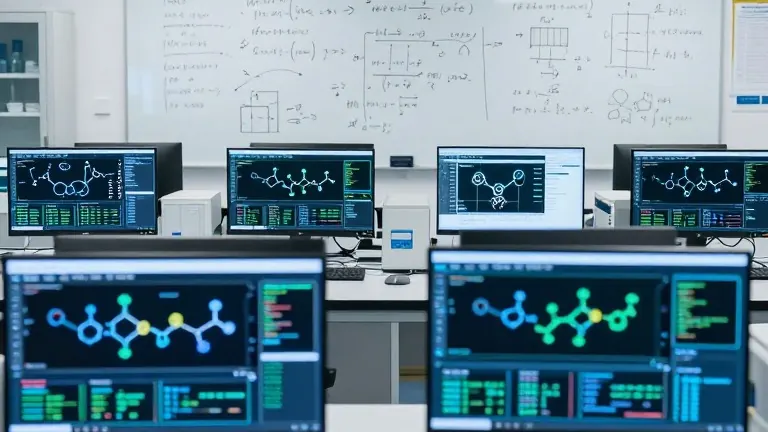
Joseph Bennett has secured a five-year National Science Foundation CAREER Award to advance his research on two-dimensional materials.
The associate professor of chemistry and biochemistry at the University of Maryland, Baltimore County, will use the funding to expand his team’s computational search for new materials. These ultra-thin sheets of atoms can exhibit electric and magnetic properties that differ from standard three-dimensional materials. Bennett’s group aims to identify candidates that could improve sensors, memory storage, and energy-efficient electronics.
The project builds on a 2025 study where Bennett’s team identified dozens of promising candidates. Those collaborators are currently synthesizing the materials in a lab. Under the new award, Bennett’s group will computationally simulate materials with different molecular building blocks, shapes, and ions. The goal is to find substances that mimic known behaviors but offer unique benefits.
Bennett described the final phase of the project as an attempt to "shoot for the home run." His team will look for electronic materials that remain stable in humid environments. This area has limited existing research, but Bennett notes it could provide a major advance for biosensors.
The grant also supports a new four-week summer training program open to undergraduates from any U.S. institution. Participants will receive data from Bennett’s lab, perform calculations, and work with mentors to draft a manuscript. The curriculum is designed to teach the full scientific process, including peer review and publication.
Bennett teaches using open-source tutorials he developed with his students. This approach allows learners to practice with real-world data rather than using black-box software. Students learn to set up simulations, interpret results, and identify errors. These skills in high-throughput computing and data analysis are becoming standard in modern chemistry as artificial intelligence tools advance.
Bennett, a 2026 fellow of the Molecular Sciences Software Institute, is incorporating these tools into his courses. He is currently refreshing his own skills in Python and Jupyter notebooks to better instruct students. He deliberately includes imperfect data sets to teach students how to handle coding errors and file issues. Bennett said he wants to help students develop a growth mindset by keeping them questioning, learning, and doing.
Source: UMBC News
More Business · Watch Your Wallet · Report a business · Got a Story?